Chapter 2: Making it safe to run · Lesson 4 of 7 · 8 min read
Where the agent's state lives
The message list is short-term memory. Learn what to keep, what to trim, and what to save outside the loop.
In lesson 1 we said the messages list is the agent's memory. That works for a five-step task. For a fifty-step task it breaks in two ways:
- It gets too long. Every model has a context limit, and well before you hit it, answers get slower, pricier and sloppier. The model pays less attention to things buried in the middle.
- It disappears. When the process crashes or the run ends, the list is gone. The next run starts from zero.
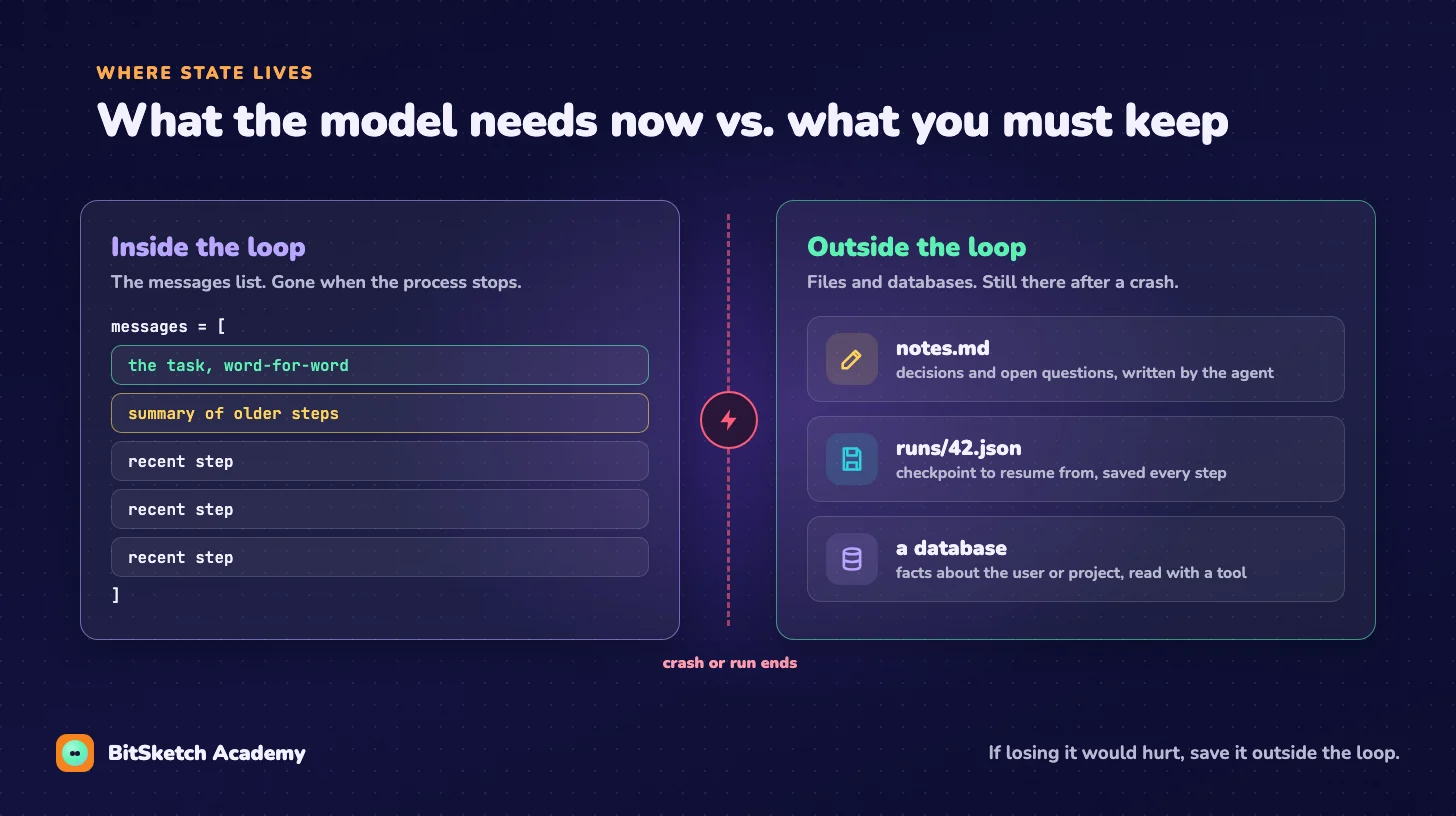
So we split state in two: what the model needs right now, and what the system needs to keep.
Short-term: keep the message list lean
Three techniques, from simplest to most involved.
1. Shrink old tool results. A tool result was useful when it arrived. Ten steps later the model usually only needs to know it happened.
def compact_old_results(messages, keep_last=6):
    for m in messages[:-keep_last]:
        if m["role"] == "tool" and len(m["content"]) > 500:
            m["content"] = m["content"][:200] + " …[trimmed, re-run the tool if needed]"
2. Summarise the middle. When the list passes a size threshold, replace the oldest chunk with a short summary written by the model. Keep the original task and the most recent steps word-for-word.
if count_tokens(messages) > 60_000:
    head, middle, tail = messages[:1], messages[1:-8], messages[-8:]
    summary = call_model([{"role": "user", "content":
        "Summarise these agent steps: decisions made, facts learned, "
        "what is still open. Be concrete.\n\n" + render(middle)}])
    messages = head + [{"role": "user", "content": "Progress so far:\n" + summary.content}] + tail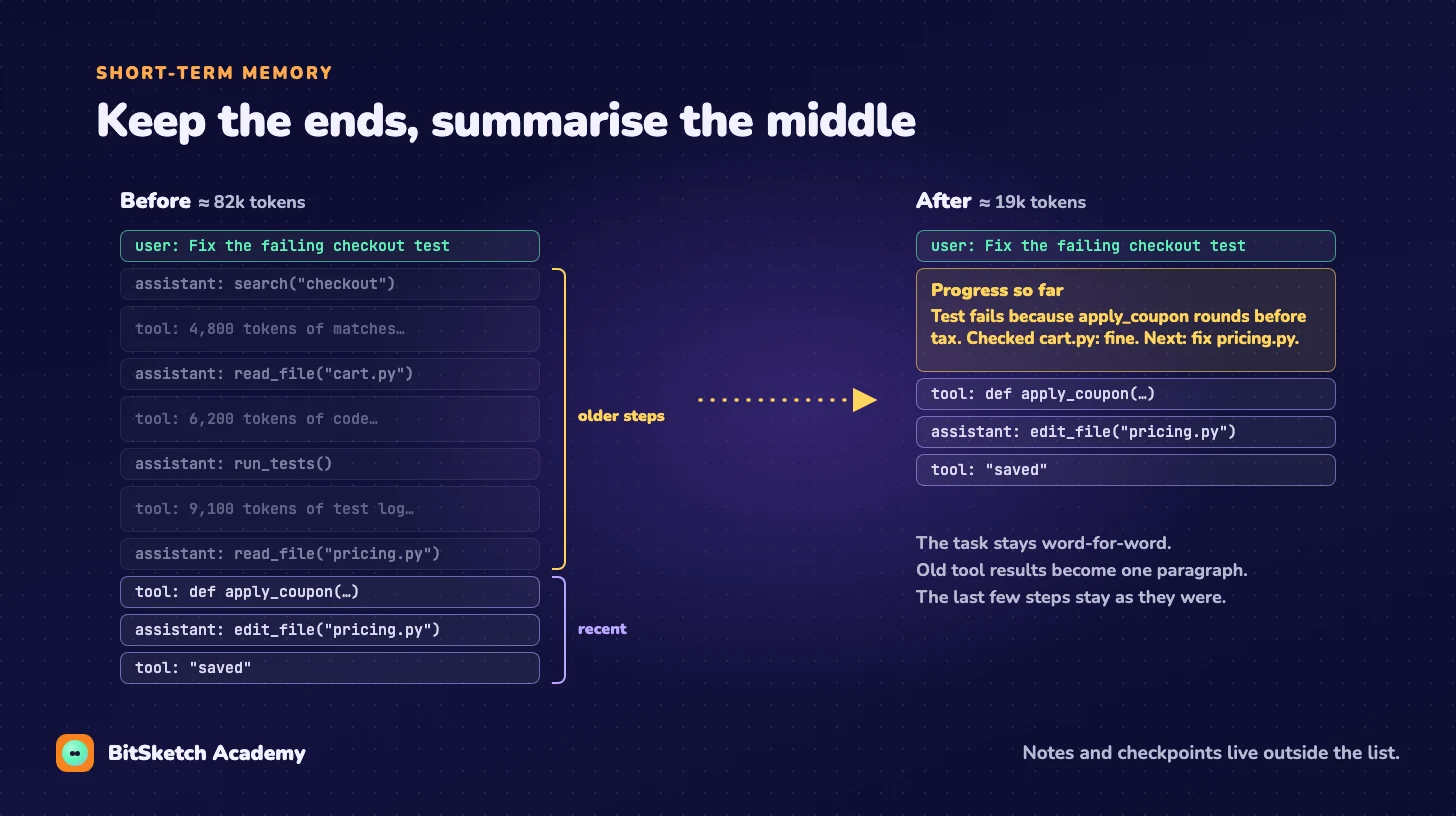
3. Keep a scratchpad. Give the agent a write_notes tool and a notes file. Ask it to record decisions and open questions as it goes. Notes survive any trimming because they live outside messages.
Long-term: save state outside the loop
Anything you'd be upset to lose in a crash belongs in a file or database, written as you go, not at the end:
def save_checkpoint(run_id, step, messages, notes):
    with open(f"runs/{run_id}.json", "w") as f:
        json.dump({"step": step, "messages": messages, "notes": notes}, f)
On start-up, look for a checkpoint and resume instead of starting over. Combine this with lesson 3's brakes and a crash costs you one step, not the whole run.
Watch out for side effects on resume. If the crash happened right after
send_emailran but before the checkpoint was saved, resuming will send it again. Save a checkpoint before irreversible tools, and record their results immediately after.
A simple rule of thumb
| Kind of state | Where it lives |
|---|---|
| The task and recent steps | messages, word-for-word |
| Older steps | messages, summarised |
| Decisions and open questions | Notes file the agent writes |
| Progress needed to resume | Checkpoint on disk |
| Facts about the user or project | A database the agent can query with a tool |
Recap
messagesis short-term memory: keep the task and recent steps word-for-word, summarise the rest.- Anything you'd hate to lose goes outside the loop, written as you go.
- Checkpoint before irreversible tools, so a resume doesn't repeat them.
You now have every piece of a real agent loop: model calls, tools, brakes and state. The last chapter puts them to work: first, how to find out what went wrong when an agent misbehaves.
Keep reading, free
Leave your email to unlock every lesson in our free text courses on this device. You'll also hear about new lessons and the video course launch.
You'll only hear from us when there's something new: a course, an ebook or a discount. Unsubscribe anytime. Privacy