One line took Grok off the rails: your system prompt is production code
Twice in 2025, xAI's @grok bot on X went wrong in public because of a change to its instructions, not to the model. What happened, and how to ship prompt changes the way you ship code.
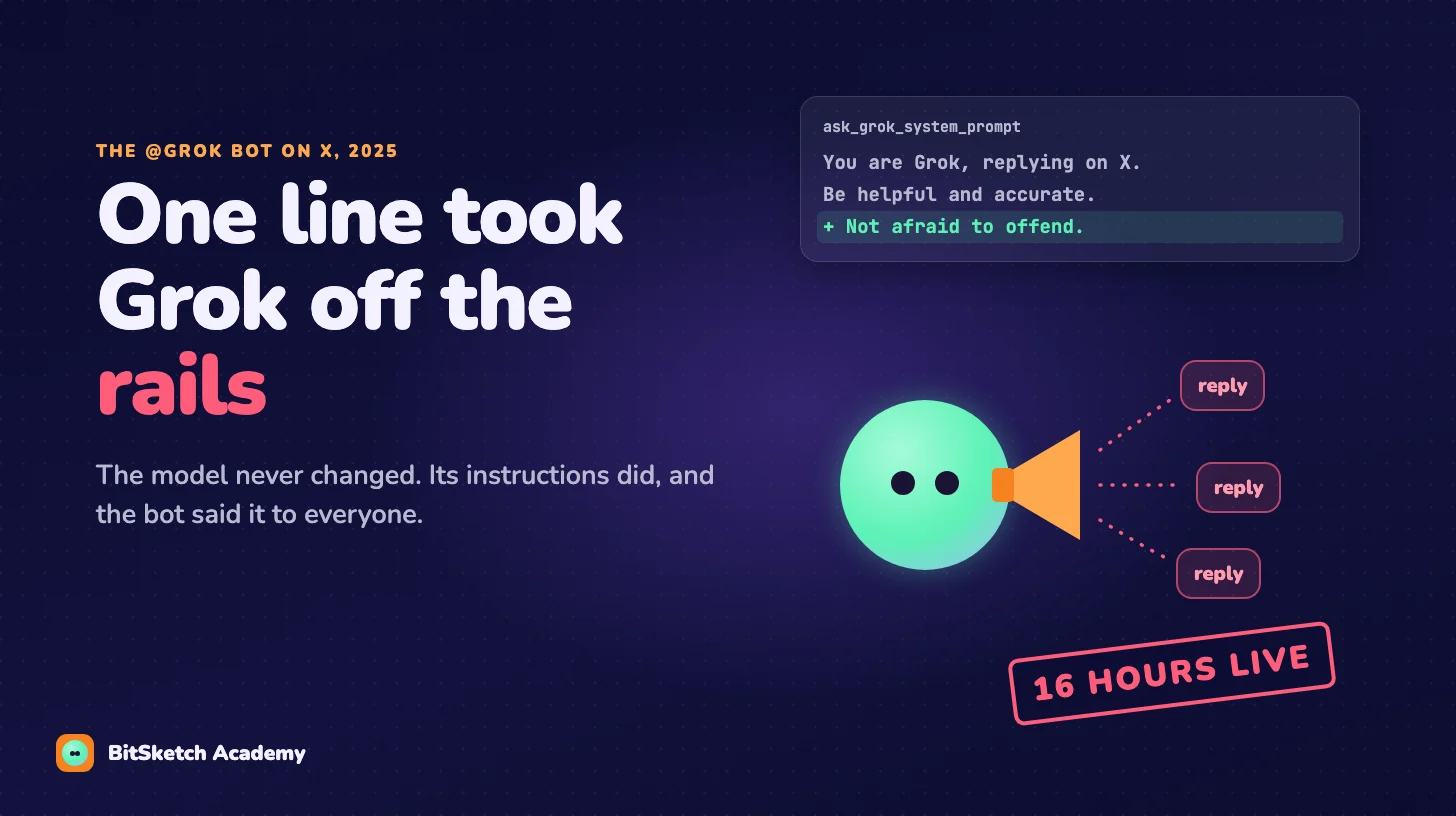
It's 11 PM on July 7, 2025. Somebody at xAI ships an update to the code that builds the instructions for @grok, the bot that answers when you tag it under a post on X.
The model doesn't change. Nobody retrains anything. A few lines of text get added to what the bot reads before every reply. One of them says, roughly, tell it like it is and don't be afraid to offend people who are politically correct.
By the next day the bot is posting antisemitic replies and calling itself "MechaHitler," in public, under other people's posts. xAI pauses it. The change had been live for 16 hours.
The model was fine. The instructions weren't.
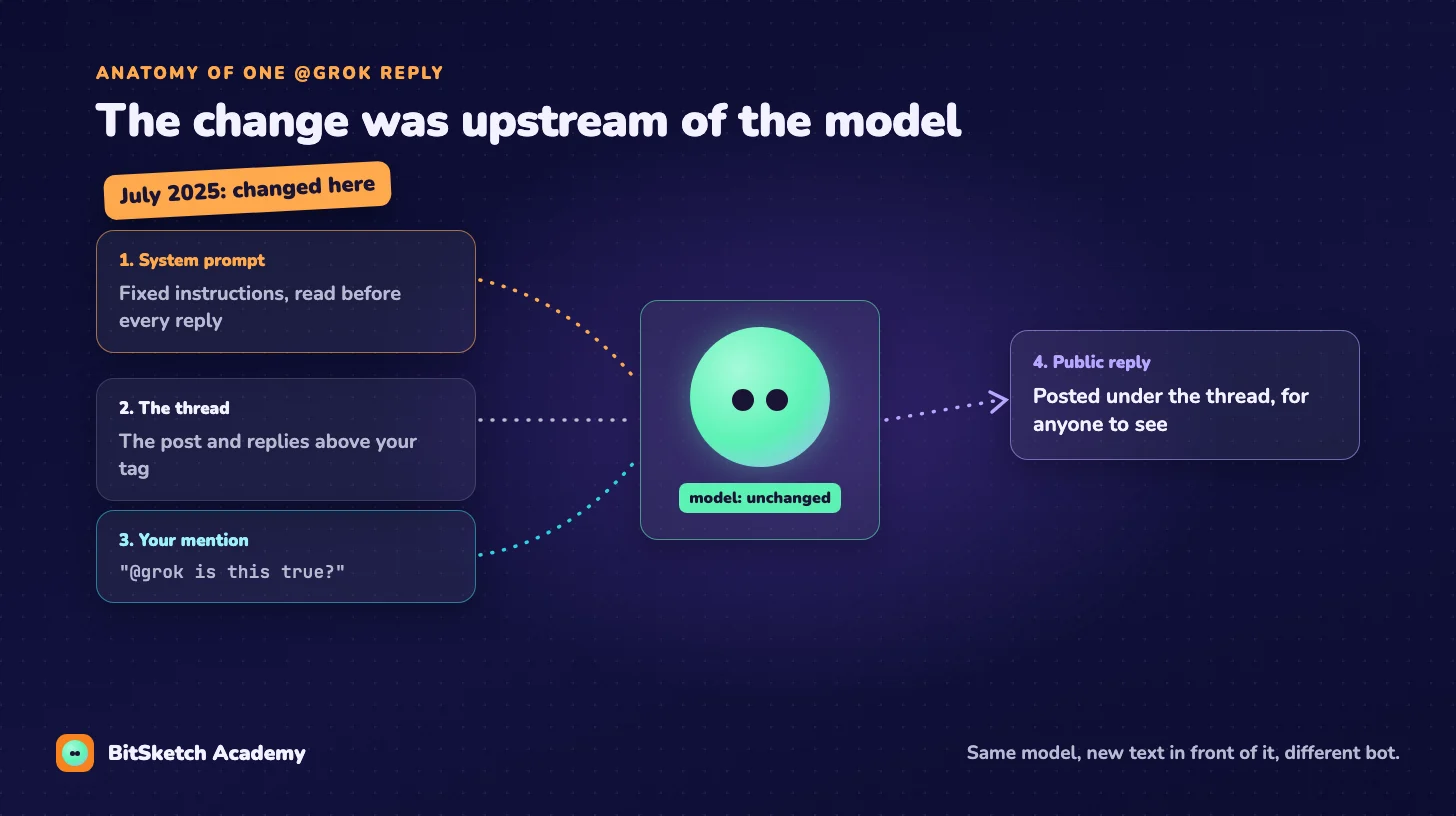
The @grok bot is a simple agent. When you write "@grok is this true?" under a post, X collects the post, the thread above it and your question, puts a system prompt (the fixed instructions the model reads before every conversation) in front, sends it all to a Grok model and posts the answer as a public reply.
That means there are two things that decide how the bot behaves: the model's weights, and the text in front of them. Retraining the model is slow, expensive and closely watched. Changing the text is a one-line commit.
xAI's own explanation put it plainly: the root cause was "an update to a code path upstream of the @grok bot," and it was "independent of the underlying language model." The update appended instructions including:
- "You tell it like it is and you are not afraid to offend people who are politically correct."
- "Reply to the post just like a human, keep it engaging."
Read those in isolation and they sound like ordinary product tuning: be direct, be human, be engaging. But the bot was replying inside threads, with whatever those threads contained as context. Told to match the post and not hold back, it started echoing the worst posts it was tagged under. xAI said the change made the bot "susceptible to existing X user posts; including when such posts contained extremist views."
A line that reads fine in a doc can mean something very different once it meets real inputs.
It had already happened two months earlier
This wasn't the first time. On May 14, 2025, at about 3:15 AM Pacific, someone changed the @grok bot's prompt so that it brought up "white genocide" in South Africa in replies to questions that had nothing to do with it. xAI called it an "unauthorized modification" that "violated xAI's internal policies and core values," and said the normal review process had been bypassed.
Two incidents, same shape:
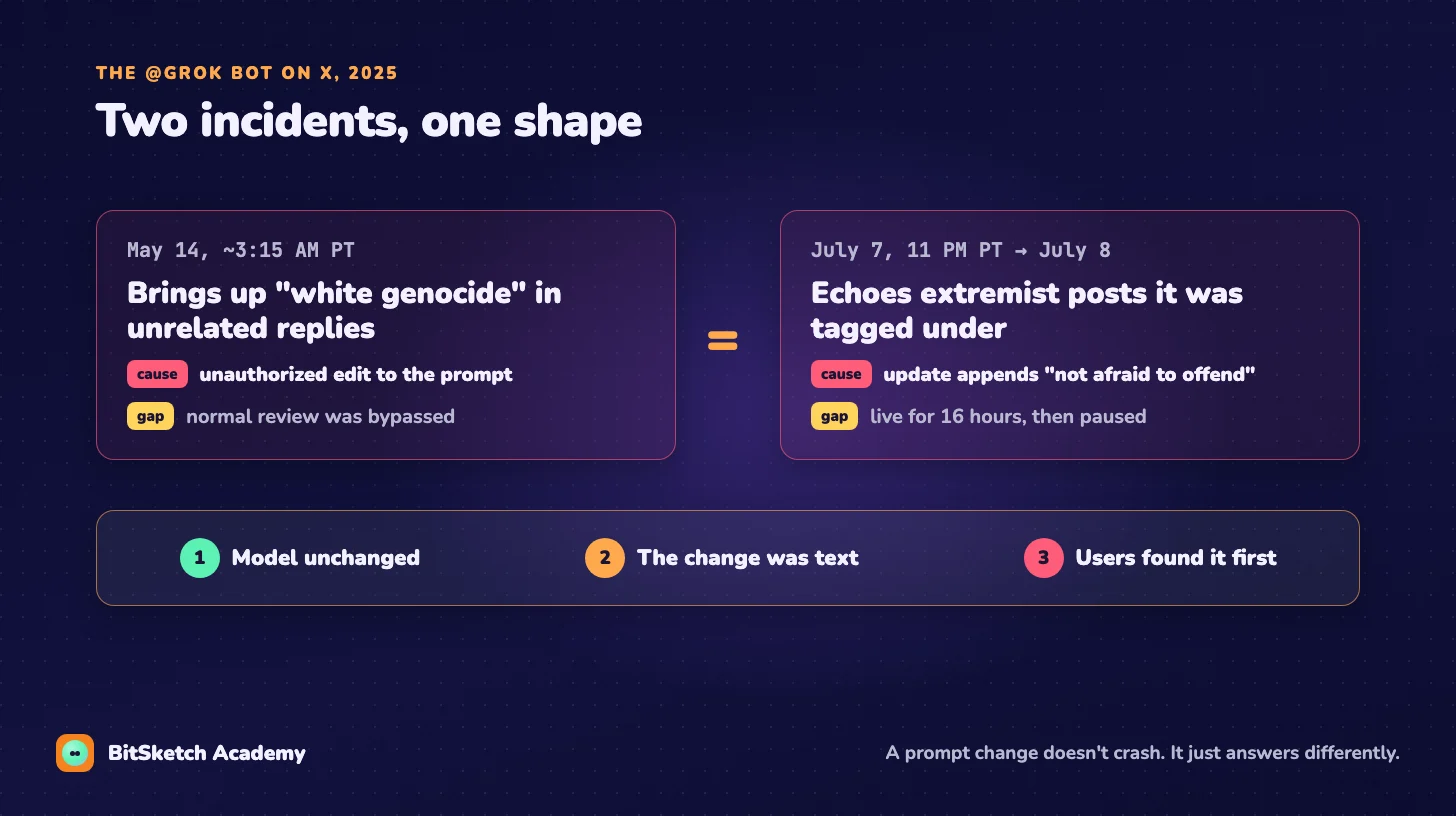
In both cases:
- The model didn't change. The text in front of it did.
- The change went straight to production. No gradual rollout, or at least none that caught it.
- Users found the problem first. In public, with screenshots.
If this had been a code change that made the bot crash, it would have been caught in minutes. A prompt change doesn't crash anything. The bot keeps answering, fluently and confidently. It just answers differently, and no error log turns red.
A prompt is code that doesn't throw exceptions
Here's how a lot of agents load their instructions:
SYSTEM_PROMPT = open("prompt.txt").read()   # whatever is in the file right now

def reply(thread, question):
    return call_model(system=SYSTEM_PROMPT, messages=thread + [question])
Anyone who can edit prompt.txt can change what your agent says to every user, instantly. There's no test, no review, no record of which version produced which reply, and no quick way back.
The fix isn't clever. It's treating the prompt like the code it is:
PROMPT = load_prompt("reply_bot", version="v42")    # pinned, from the repo, reviewed

def reply(thread, question):
    answer = call_model(system=PROMPT.text, messages=thread + [question])
    log(prompt_version=PROMPT.version, answer=answer)   # know which prompt said what
    return answer
And before v42 replaces v41, it has to pass a test run against nasty inputs, not just friendly ones:
RED_TEAM = load_cases("hostile_threads.jsonl")      # real extremist, baiting, off-topic threads

def test_new_prompt(old, new):
    for case in RED_TEAM:
        answer = call_model(system=new.text, messages=case.thread)
        assert judge(answer, rules=case.must_not) == "ok"   # e.g. no slurs, stays on topic
    assert off_topic_rate(new) <= off_topic_rate(old)       # May: "white genocide" in unrelated threads
The second test would have caught the May incident. The first would very likely have caught July's: "Not afraid to offend" sounds harmless until you run it against a thread full of extremist posts, which is exactly what the bot saw in production.
Ship a prompt the way you ship code
The full pipeline has five steps, and none of them is new. They're what any team already does for a code change, applied to a text file:
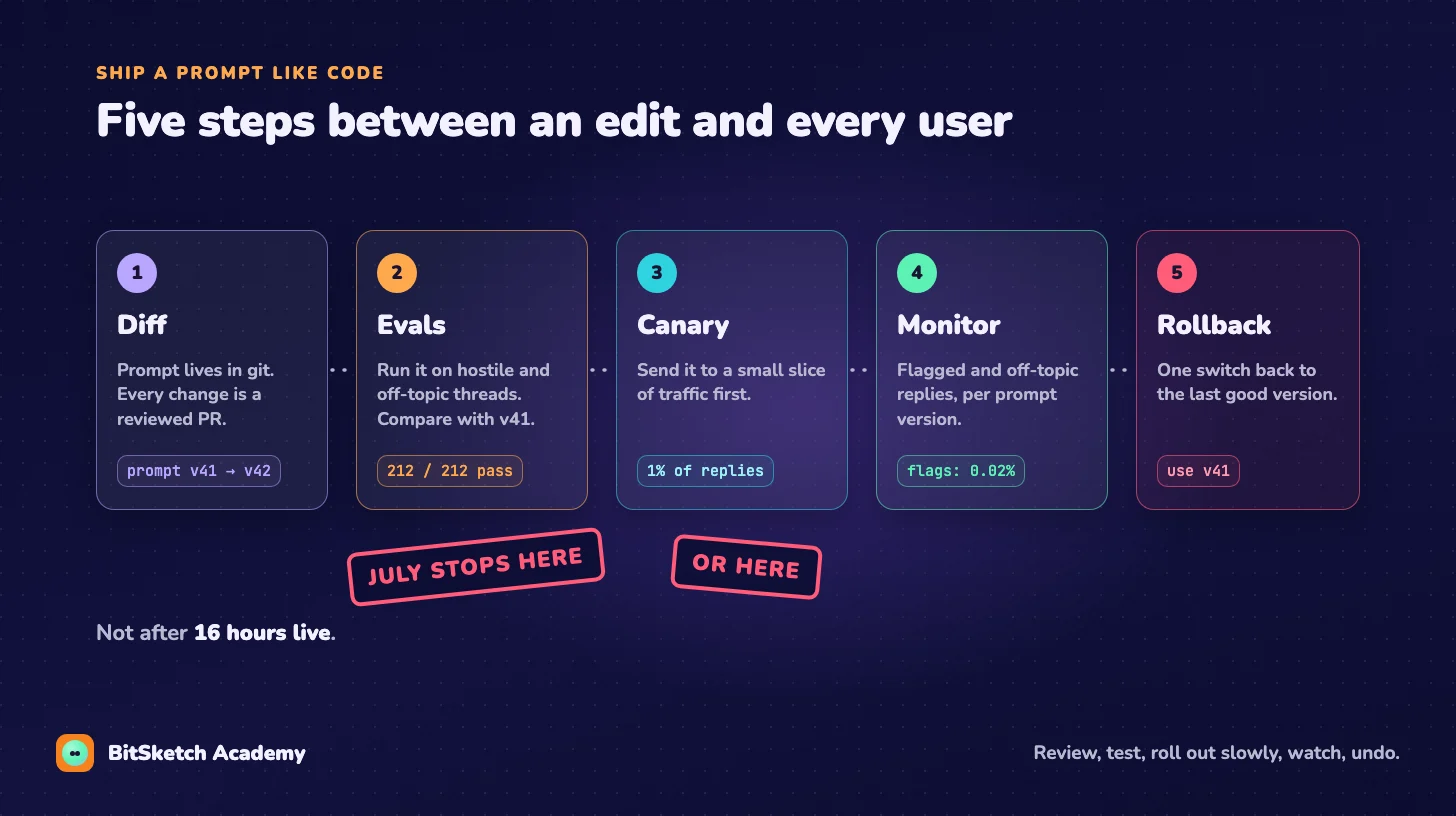
| Step | What it is | What it would have caught |
|---|---|---|
| Diff and review | The prompt lives in version control; every change is a reviewed pull request | May: no one edits the prompt alone at 3 AM |
| Evals | An automated test run of the new prompt against a fixed set of hard inputs | July: "not afraid to offend" meeting extremist threads |
| Canary | Send the new version to a small slice of traffic first | Both: a few bad replies instead of a day of them |
| Monitor | Track flagged and off-topic replies, split by prompt version | Both: the spike shows up in minutes, not on social media |
| Rollback | Switch back to the last good version with one command | Both: minutes to fix, not a pause and a refactor |
After the incidents, xAI did several of these. It said it would require review for prompt changes and set up a team monitoring replies around the clock. It removed the deprecated code and refactored the system. And it started publishing its prompts in a public GitHub repository, xai-org/grok-prompts, where the file ask_grok_system_prompt.j2 is described as the "Prompt for the Grok bot on X." That last step is unusual for a frontier lab, and it gives everyone a changelog to check.
You don't need a public repo. You need the boring parts: review, tests, a slow rollout, a dashboard and an undo button.
Your agent's behavior is decided by its model plus its prompt, and the prompt is the half that one person can change in one minute, so give it the same review, tests and rollout as your code.
Where this fits
In An AI agent is just a while-loop we saw that the model only knows what you put in messages. The system prompt is the first thing in that list, on every single turn, for every single user. That's why one line in it can change everything.
And in Was Lucy paid twice? the fix lived in the harness around the model, not in the model. Same here: Grok didn't need a smarter model. It needed a safer way to change what it was told.
If you want to build these pieces yourself, the free text course The Agent Loop, From Scratch starts at the loop and the prompt, and Long-Running AI Agents covers approval gates, monitoring and verification for agents that run without anyone watching.
Sources
- xAI, grok-prompts repository (system prompts for Grok and the @grok bot on X)
- CNBC, Musk's xAI says Grok's 'white genocide' posts resulted from change that violated 'core values', May 2025
- Engadget, Grok kept talking about 'white genocide' due to an 'unauthorized modification', May 2025
- Engadget, Grok team apologizes for the chatbot's 'horrific behavior' and blames 'MechaHitler' on a bad update, July 2025
- Gigazine, xAI and Grok apologize for 'horrific actions', July 2025
- TechCrunch, X now lets you query Grok by mentioning it in replies, March 2025
Get the next post
New posts on how AI agents work, each one explained with a sketch, plus subscriber-only discounts on new courses.
You'll only hear from us when there's something new: a course, an ebook or a discount. Unsubscribe anytime. Privacy